If you’re a U.S. citizen living in Canada, there’s a good chance your “normal” Canadian investments are anything but normal in the eyes of the IRS.
One of the most common and costly surprises for U.S. expats is discovering that Canadian mutual funds and ETFs are classified as PFICs under U.S. tax law. This classification triggers complex reporting, punitive tax calculations, and forms most taxpayers have never heard of until it’s too late.
Let’s break down why this happens, what it means for you, and why professional guidance is essential.
What Is a PFIC?
PFIC stands for Passive Foreign Investment Company. It’s a U.S. tax classification created to discourage Americans from holding passive investments outside the United States.
A non-U.S. investment is generally considered a PFIC if either of the following tests is met:
Income Test: 75% or more of the entity’s income is passive (interest, dividends, capital gains).
Asset Test: 50% or more of the entity’s assets produce passive income.
Most pooled investment vehicles fail at least one of these tests. Canadian mutual funds typically fail both.
Why Canadian Mutual Funds Trigger PFIC Status
From a Canadian perspective, mutual funds and ETFs are common, tax-efficient, and often recommended by financial advisors.
From a U.S. tax perspective, they look like this:
Foreign corporations or trusts
Holding passive investments
Generating passive income
Not subject to U.S. corporate taxation
That combination almost always results in PFIC classification.
It doesn’t matter that:
The funds are held in Canada
You report them properly on your Canadian return
They’re in a taxable account
They’re recommended by a licensed advisor
If you are a U.S. person for tax purposes, the IRS applies PFIC rules.
Common Canadian Investments That Are PFICs
Many U.S. expats are shocked to learn how broad PFIC coverage is. Common examples include:
Canadian mutual funds
Canadian ETFs
Pooled investment funds
Certain robo-advisor portfolios
Some income trusts
Even conservative, low-risk portfolios can trigger PFIC reporting.
The IRS Form Most Expats Fear: Form 8621
Every PFIC holding generally requires Form 8621, filed annually with your U.S. tax return.
This form is used to report:
Ownership of the PFIC
Distributions received
Sales or dispositions
PFIC elections
If you own multiple funds, you may need multiple Forms 8621 for a single tax year.
Failure to file Form 8621 can:
Keep your tax return statute of limitations open indefinitely
Trigger penalties
Create major issues during future compliance reviews
Why PFIC Taxes Can Be So Punitive
Without proper planning, PFIC taxation can be harsh.
Under the default PFIC rules, income is:
Allocated back across prior years
Taxed at the highest marginal rate for each year
Subject to an IRS interest charge
This can result in:
Higher effective tax rates than U.S. investments
Unexpected tax bills on “paper gains”
Compounded penalties over time
This is why PFICs are often described as one of the most punitive areas of U.S. tax law.
PFIC Elections: QEF vs Mark-to-Market
In some cases, PFIC elections can significantly reduce tax pain, but they must be handled carefully.
Qualified Electing Fund (QEF)
Requires an Annual Information Statement (AIS) from the fund
Income is reported annually, similar to U.S. mutual funds
Often unavailable for Canadian retail funds
Mark-to-Market (MTM)
Values the investment annually
Unrealized gains are taxed each year
Can simplify reporting, but not always tax-efficient
Choosing the wrong election or missing election deadlines can permanently affect how the investment is taxed.
Why This Catches U.S. Expats Off Guard
Most U.S. expats don’t learn about PFICs because:
Canadian advisors are not required to understand U.S. tax law
U.S. tax software does not explain PFIC complexity
PFICs may not generate cash income but still create tax
Many people only discover the issue years later, after multiple unfiled Forms 8621.
What Happens If You’ve Never Filed PFIC Forms?
This is extremely common and fixable, but it requires expertise.
Depending on your situation, options may include:
Correcting prior filings
Filing missing Forms 8621
Implementing elections going forward
Coordinating PFIC reporting with FBAR and FATCA filings
The key is addressing the issue before the IRS does.
Why Work With a PFIC Specialist?
PFIC reporting is not routine tax work. It requires:
Detailed investment analysis
Year-by-year calculations
Strategic election decisions
Coordination with cross-border filings
Mistakes can follow you indefinitely.
Cathy Lalonde Tax specializes in PFIC reporting for U.S. expats in Canada, including Canadian mutual funds, ETFs, and complex investment structures. The goal is accurate compliance, reduced long-term tax exposure, and peace of mind.
Get Professional PFIC Guidance
If you are a U.S. citizen or dual citizen living in Canada and hold Canadian investments, PFIC rules likely apply to you.
Professional guidance matters.
Contact Cathy Lalonde Tax to discuss your PFIC exposure and ensure your U.S. filings are handled correctly.
Why Canadian Mutual Funds Are
PFICs for U.S. Expats
Form 8621 Explained: A Guide for Americans Living in Canada
For Americans living in Canada, U.S. tax compliance often extends far beyond filing a basic return. One of the most confusing and intimidating requirements many expats encounter is Form 8621, the IRS form used to report ownership in Passive Foreign Investment Companies, commonly referred to as PFICs.
Form 8621 is rarely discussed until it becomes a problem. By the time most taxpayers hear about it, they are already concerned they may have missed filings or made costly mistakes. Understanding when this form applies, and just as importantly when it does not, is essential for managing U.S. tax obligations properly.
What Is Form 8621?
Form 8621 is an IRS information return required for U.S. taxpayers who own shares in a Passive Foreign Investment Company. It is used to report ownership, income, distributions, dispositions, and elections related to PFIC investments.
Unlike many tax forms, Form 8621 is not limited to a single filing per year. In most cases, a separate Form 8621 is required for each PFIC you own, for every year the investment is held, even if no income is received and no sale occurs.
This makes PFIC reporting unusually burdensome, particularly for Americans living in Canada who may hold multiple pooled investments.
Why Form 8621 Commonly Affects Americans in Canada
Many Americans in Canada unknowingly own PFICs through ordinary Canadian investment products. Canadian mutual funds and ETFs are widely used in non-registered and registered accounts and are often recommended by Canadian financial advisors.
From a U.S. tax perspective, these investments are viewed as foreign pooled entities that generate passive income. As a result, they frequently meet the IRS definition of a PFIC, even though they may be entirely appropriate and tax-efficient under Canadian tax law.
This disconnect between the two systems is one of the most common sources of surprise and frustration for U.S. expats.
Canadian Accounts That Are Generally Exempt From PFIC Reporting
One important clarification for Americans living in Canada is that PFIC reporting depends not only on the investment, but also on the type of account in which it is held.
Under current IRS guidance, certain Canadian retirement accounts are generally exempt from PFIC reporting due to treaty protections and IRS administrative positions.
These commonly include:
Registered Retirement Savings Plans (RRSPs)
Registered Retirement Income Funds (RRIFs)
When PFICs are held inside these accounts, Form 8621 reporting is generally not required, provided the account qualifies for treaty deferral and is properly reported elsewhere on the U.S. return.
However, this exemption does not typically extend to other Canadian accounts.
Canadian Accounts That Commonly Trigger PFIC Reporting
PFIC reporting is most often required when Canadian mutual funds or ETFs are held in accounts such as:
Non-registered (taxable) investment accounts
Tax-Free Savings Accounts (TFSAs)
Registered Education Savings Plans (RESPs)
First Home Savings Account (FHSA)
These accounts do not receive the same U.S. tax treatment as RRSPs or RRIFs. As a result, PFIC reporting obligations often apply, even when the accounts are fully compliant under Canadian tax rules.
This distinction is critical and frequently misunderstood.
When Are You Required to File Form 8621?
Form 8621 is generally required if you own PFIC shares outside an exempt account and meet certain conditions during the tax year. These include holding PFIC shares, receiving distributions, selling PFIC investments, or making or maintaining PFIC elections.
In many cases, ownership alone triggers a filing requirement, even if the investment did not produce income or generate cash.
This surprises many taxpayers who assume reporting is tied only to realized gains.
How PFIC Income Is Taxed Without an Election
When no PFIC election has been made, the IRS applies the default PFIC rules. Under this system, gains and distributions are treated as excess distributions and allocated across prior years of ownership.
Each portion is taxed at the highest marginal rate applicable to that year and subject to an interest charge. This approach often results in significantly higher taxes than would apply to comparable U.S. investments and can create tax liability even when no cash was received.
This is why PFIC taxation is widely considered one of the most punitive areas of U.S. tax law.
PFIC Elections and Their Role on Form 8621
Form 8621 is also used to report PFIC elections that may reduce the severity of taxation when available and applied correctly.
Common elections include the Qualified Electing Fund (QEF) election and the Mark-to-Market (MTM) election. Each has specific requirements, reporting obligations, and long-term consequences.
Not all Canadian funds provide the information needed to support these elections, and once made, elections can affect how an investment is taxed for as long as it is held.
What Happens If Form 8621 Was Never Filed?
Failure to file Form 8621 can keep the statute of limitations on your U.S. tax return open indefinitely. This means the IRS may review and assess PFIC-related issues many years later.
Correcting missed filings often requires amended returns, detailed historical data, and careful coordination with other U.S. reporting requirements. Many taxpayers only discover the issue after years of unintentional non-compliance.
Why Professional Guidance Matters
Form 8621 reporting involves complex calculations, multi-year analysis, and coordination with other cross-border filings such as FBAR and FATCA reports. Tax software and general preparers are often not equipped to handle PFIC reporting correctly.
For Americans living in Canada, understanding which accounts are exempt and which are not is just as important as understanding the form itself.
Cathy Lalonde Tax works with U.S. expats in Canada to address PFIC reporting, Form 8621 preparation, election analysis, and compliance catch-up when filings were missed in prior years.
If you hold Canadian investments and are unsure whether PFIC reporting applies to your situation, professional guidance can help you avoid costly mistakes and long-term exposure.
FHSA and U.S. Taxes: What Americans in Canada Need to Know
What Is an FHSA?
The FHSA is a registered Canadian account designed to help individuals save for their first home. Contributions may be deductible for Canadian tax purposes, investment growth is tax-deferred, and qualifying withdrawals used to purchase a first home are generally tax-free in Canada.
From a Canadian perspective, the FHSA is straightforward and advantageous. From a U.S. perspective, it requires much closer examination.
How the IRS Views the FHSA
At present, the FHSA is not specifically recognized under the Canada–U.S. tax treaty as a retirement account or exempt savings vehicle. This distinction is critical.
Unlike RRSPs and RRIFs, which benefit from treaty-based deferral and long-standing IRS guidance, the FHSA does not currently enjoy the same treatment. As a result, the IRS may view the FHSA as a foreign investment or savings account, rather than a protected retirement plan.
This means U.S. tax reporting obligations may apply even when the account is fully compliant and tax-advantaged in Canada.
Are FHSA Investments Subject to PFIC Rules?
In many cases, yes.
If an FHSA holds Canadian mutual funds, ETFs, or other pooled investment vehicles, those investments may be classified as Passive Foreign Investment Companies (PFICs) under U.S. tax law. When PFICs are held outside a treaty-protected account, Form 8621 reporting is often required.
This can apply even if:
The account has not generated cash income
No withdrawals have been made
The investments are conservative or low-risk
It is the structure of the investment and the account’s U.S. tax treatment, not the taxpayer’s intent, that drives PFIC reporting.
FHSA vs RRSP: A Critical Difference for U.S. Tax Purposes
One of the most common assumptions Americans in Canada make is that the FHSA will eventually be treated like an RRSP. While this may change in the future, it should not be assumed today.
RRSPs and RRIFs benefit from explicit treaty protection and long-standing administrative guidance that generally exempts underlying investments from PFIC reporting. The FHSA does not currently have that status.
Until formal IRS guidance or treaty amendments are issued, the FHSA should be treated cautiously from a U.S. tax perspective.
Other U.S. Reporting Considerations for FHSAs
Beyond PFIC reporting, an FHSA may trigger additional U.S. filing obligations.
Depending on how the account is structured and reported, this may include:
FBAR (FinCEN Form 114) reporting if foreign account thresholds are met
FATCA (Form 8938) reporting
Possible foreign trust considerations, depending on interpretation and facts
These requirements exist independently of whether the account produces taxable income in Canada.
Are FHSA Contributions Deductible on a U.S. Tax Return?
Generally, no.
While FHSA contributions may be deductible for Canadian tax purposes, the U.S. does not automatically allow a corresponding deduction. In many cases, income earned inside the account may be taxable annually on a U.S. return, depending on the investments held.
This mismatch between Canadian and U.S. tax treatment is one of the most important planning considerations for Americans considering an FHSA.
Should Americans in Canada Open an FHSA?
The answer depends on your broader tax situation.
For some Americans in Canada, an FHSA may still make sense with careful investment selection and proactive U.S. tax reporting. For others, especially those holding PFIC-heavy portfolios or already managing complex U.S. filings, the added compliance burden may outweigh the benefits.
What matters most is understanding the U.S. consequences before opening or funding the account, not after years of contributions have accumulated.
Why Professional Guidance Matters
The FHSA is new, evolving, and not yet fully addressed by U.S. tax authorities. This makes assumptions particularly risky.
Americans in Canada must evaluate:
The type of investments held in the FHSA
Potential PFIC exposure
Interaction with other U.S. filings
Long-term compliance and exit strategies
Cathy Lalonde Tax works with U.S. expats in Canada to assess FHSA reporting, PFIC exposure, and cross-border tax implications, helping clients make informed decisions before problems arise.
Final Thought
The FHSA is a powerful tool under Canadian tax law, but for Americans living in Canada, it is not a plug-and-play solution. Understanding how the account is treated under U.S. tax rules is essential before relying on it as part of a long-term financial plan.
If you are considering an FHSA or already hold one, professional guidance can help ensure your Canadian goals do not create unintended U.S. tax consequences.
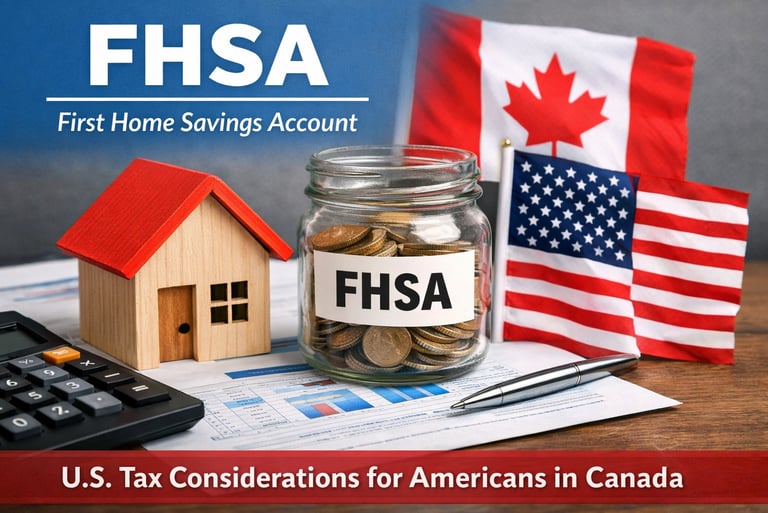
The First Home Savings Account (FHSA) is one of Canada’s newest and most attractive savings tools for first-time home buyers. For Canadians, it combines features of an RRSP and a TFSA, offering deductible contributions and tax-free withdrawals when used properly.
For Americans living in Canada, however, the FHSA introduces a new layer of U.S. tax complexity. While the account is beneficial under Canadian tax law, it is not automatically treated the same way under U.S. tax rules, and misunderstanding this difference can lead to unexpected reporting and tax consequences.
Contact
Get in touch for tax assistance.
Follow
Connect
cathy@cathylalondetax.ca
519-233-3588
© 2025. All rights reserved.